
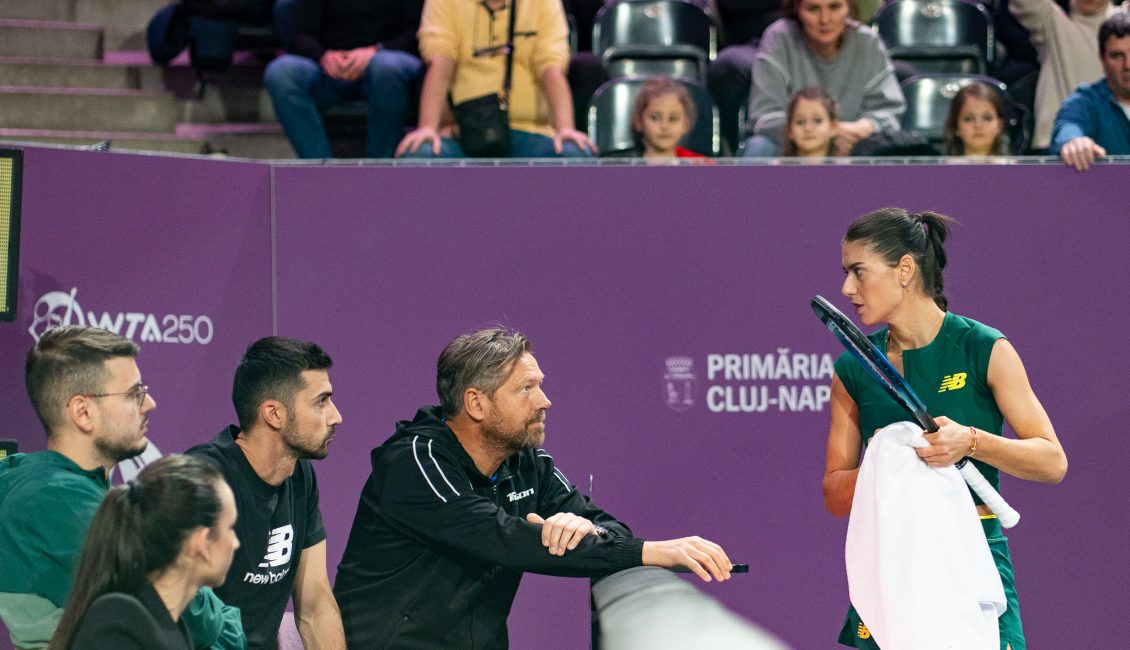
One of the most experienced coaches on tour, Sven Groeneveld is currently at the Transylvania Open alongside Sorana Cîrstea, with whom he began working a few months ago. A former player, the 59-year-old Dutchman has coached for the past 30 years in both the women’s and men’s circuits, working with stars such as Monica Seles, Arantxa Sánchez Vicario, Mary Pierce, Ana Ivanovic, Caroline Wozniacki, Maria Sharapova, and Bianca Andreescu, as well as Greg Rusedski, Nicolas Kiefer, Tommy Haas, Mario Ančić, and most recently, Botic van de Zandschulp.
In Cluj, Sven spoke to us about his coaching career and philosophy, his collaboration with Sorana, his view on modern tennis changes, and Romanian tennis’s history.
Is this your first time in Romania? How do you find the Cluj tournament?
Yes, and I am very impressed with the infrastructure and attention to detail, from how we were picked up at the airport to the hotel. It’s close to the arena, the food, the convenience, the players’ lounge, and the little details. It’s wonderful, it feels like a bigger tournament. I like how the arena is divided into two courts and the fact that you can hear two matches happening simultaneously. The practice court is excellent, the gym is as well and I’m sure that for Romanian players, it’s great to be at home.
You have an impressive coaching career. What brings you the greatest fulfillment in this role?
First of all, I need to feel that I can add value to the player, that’s number one. And number two is whether the player can teach me something as well. When I work with a player like Sorana, who has years and years of experience and her routine, it’s not about me at all, it’s more about her. It depends on the player you work with to find that necessary connection to improve the relationship so that they can reach their full potential.
How would you define your coaching style?
I see myself as a Google Maps, like having multiple satellites looking down and providing guidance to go from A to B. The most important thing is to locate where you are. If you can pinpoint where you are, it’s easier to get where you want to go than if you don’t know where you are. So that’s my role and I’m starting to see more clearly where she is, we talk about it and then we work together to get where we want to be.
I believe in the GPS approach to analyzing a player and from that, I build a plan, like you would in architecture. Sometimes I like to call myself a tennis architect. And I believe there’s still an attic where Sorana can go, maybe even a nice rooftop terrace. I use a lot of metaphors in my coaching style.
What do you think are the main characteristics of a champion?
They always want to improve, they are never satisfied, ever. That’s what truly sets them apart. Then, it’s important to remain humble, no matter how much success you achieve. I also think empathy is important in life. Understanding someone’s struggles, and that has nothing to do with tennis, it’s about life and being human. So I believe empathy and humility are key characteristics of great champions.
How do you see Romanian tennis? What have you observed over time?
Romanian players have always been a force. Virginia Ruzici, who is a very special lady to me, and Ilie Năstase. I remember being a ball kid at one of his matches and asking him for his towel. He replied, “Don’t you have a towel at home?”, with that signature sarcasm of his. So, for me, Romanian tennis has a lot of history, which is why it’s great to see a tournament like this because you want to keep this history alive and preserve its roots.
It’s often difficult to create a tennis culture. For example, in China: it’s not that easy to do that in a country without a tennis history. So I believe you need to build around this history and protect it. And, of course, what Simona Halep and Sorana have done, along with some of the male players who have performed at a very high level, show that you have a strong tennis culture and excellent development.
With Simona retiring and Sorana reaching the end of her career—both having been so influential in Romanian tennis—how do you see their legacy?
I hope they continue to inspire young players and share their experiences. And I hope Romanian tennis keeps them close and encourages them to stay involved and help the sport keep progressing. They need to remain engaged, I’m sure they will be ambassadors for the sport, but that’s a conversation you’d have to have with them. I would encourage them to stay close to tennis. They have so much to give back!
Full interview in Romanian here.


